
How AI Powered SEO Is Transforming Digital Marketing
Search Engine Optimization (SEO) is no longer just about inserting keywords into a website. Modern SEO has evolved into a highly intelligent process driven by Artificial Intelligence, machine learning, automation, and user behavior analysis. Businesses today are competing not only for visibility but also for relevance, speed, personalization, and user engagement. This transformation has changed the role of developers, marketers, and content creators across the IT industry.

The Shift from Traditional SEO to Intelligent Search
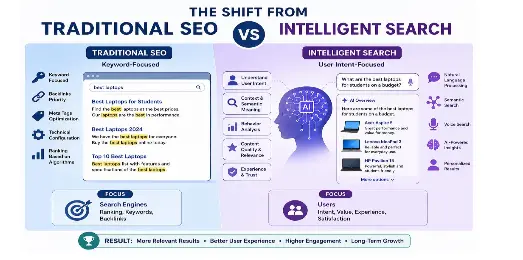
Traditional SEO was primarily built around search engine algorithms that relied heavily on keywords, backlinks, and technical configurations. Website owners focused on repeating exact-match keywords, building as many backlinks as possible, and optimizing meta tags in order to improve rankings on search engines. While these techniques are still relevant to some extent, the modern search landscape has evolved far beyond simple keyword matching.
Today, search engines such as Google use advanced Artificial Intelligence (AI) systems, machine learning models, and Natural Language Processing (NLP) technologies to better understand what users actually mean when they perform a search. Instead of simply identifying words on a page, modern search engines attempt to interpret user intent, context, semantic meaning, browsing behavior, and content quality.
For example, in the past, a website could rank highly simply by repeating the phrase “best laptops” multiple times throughout a page. Modern intelligent search systems, however, analyze whether the content genuinely helps the user. They evaluate factors such as readability, relevance, expertise, page experience, mobile responsiveness, loading speed, engagement levels, and even whether users remain on the page after clicking the result.
This shift has transformed SEO from a purely technical activity into a more user-centered and content-driven strategy. Businesses must now create meaningful, informative, and trustworthy content that genuinely answers user questions and solves problems. Search engines reward websites that provide value rather than websites that merely manipulate algorithms.
Another major change is the rise of semantic search. Intelligent search systems can now understand related concepts and synonyms rather than relying only on exact keywords. For instance, a search for “cheap smartphones” may also return pages discussing “budget mobile devices” because the AI understands the relationship between the two phrases. This allows search engines to deliver more accurate and personalized results to users.
Artificial Intelligence has also introduced features such as voice search, predictive search suggestions, AI-generated summaries, and conversational search experiences. Users increasingly interact with search engines in a more natural way by asking complete questions rather than typing isolated keywords. As a result, websites must adapt their content to match conversational language and real-world user behavior.
In addition, user experience has become a critical ranking factor. Search engines now prioritize websites that are fast, secure, mobile-friendly, visually organized, and easy to navigate. This means that developers, designers, and marketers must work together closely to improve both technical performance and content quality.
The shift from traditional SEO to intelligent search represents a major transformation in digital marketing and web development. Success today depends not only on understanding algorithms, but also on understanding people — their needs, behaviors, preferences, and search intentions. Companies that embrace AI-driven SEO strategies will be better positioned to improve online visibility, build trust with users, and maintain long-term digital growth.
Why AI Matters in Digital Marketing
Artificial Intelligence (AI) has become one of the most powerful technologies in modern digital marketing. Businesses today collect enormous amounts of customer data from websites, social media platforms, search engines, mobile applications, and online advertisements. AI helps companies analyze this data quickly and accurately in order to understand customer behavior, preferences, and purchasing patterns.
AI-powered tools can identify trending topics, predict customer interests, optimize advertisements, and automate marketing campaigns with far greater efficiency than traditional methods. For example, AI can analyze user activity and recommend the best keywords, posting times, advertisement placements, and content strategies to improve engagement and conversion rates.
Modern marketers also use AI for SEO audits, competitor analysis, keyword clustering, performance tracking, and content recommendations. Machine learning algorithms can detect patterns in search behavior and help businesses create more personalized and targeted marketing campaigns. This allows companies to deliver the right content to the right audience at the right time.
In addition, AI-driven automation tools reduce manual work by handling tasks such as email marketing, chatbot support, customer segmentation, and data reporting. As a result, businesses can improve productivity, reduce costs, and make faster marketing decisions while providing a better customer experience.
The Role of Developers in Modern SEO
Developers now play a critical role in the success of digital marketing and SEO strategies. Modern websites must not only look attractive but also perform efficiently, load quickly, and provide a smooth user experience across all devices. Many of these factors are directly connected to development work rather than traditional marketing alone.
Technical areas such as website performance, mobile responsiveness, structured data, API integrations, accessibility, security, and page speed optimization all influence how search engines rank websites. Search engines like Google prioritize websites that are fast, secure, user-friendly, and optimized for both desktop and mobile users.
Developers are also responsible for implementing technical SEO elements such as clean website architecture, optimized code, schema markup, XML sitemaps, and proper indexing structures. These improvements help search engines better understand website content and improve search visibility.
In today’s digital environment, Assistant Developers and software engineers increasingly collaborate with SEO specialists, content creators, and marketing teams to improve website performance and customer engagement. This close collaboration helps businesses create websites that are not only technically strong but also optimized for higher traffic, better rankings, and improved user experience.
How Automation Is Changing SEO
Automation has significantly transformed the way businesses manage SEO and digital marketing operations. In the past, SEO professionals had to perform many repetitive and time-consuming tasks manually, including keyword research, technical audits, backlink analysis, content publishing, metadata creation, performance monitoring, and report generation. Today, automation tools powered by Artificial Intelligence (AI) can handle many of these processes quickly, accurately, and efficiently.
Modern SEO platforms can automatically scan websites to detect technical issues such as broken links, duplicate content, missing metadata, slow-loading pages, and mobile usability problems. Automated systems can also monitor keyword rankings, track competitor performance, schedule content publishing, and generate detailed analytics reports in real time.
AI-driven automation allows businesses to manage large-scale marketing operations with greater speed and consistency. For example, companies can automatically personalize email campaigns, optimize advertisements, generate SEO-friendly metadata, and recommend content improvements based on user behavior and search trends. This reduces manual workload while improving overall marketing performance.
Automation also helps businesses make faster and more data-driven decisions. Instead of spending hours collecting and analyzing information manually, marketers can access real-time insights and performance metrics instantly. This improves productivity, reduces operational costs, and allows teams to focus more on strategy, creativity, and customer engagement.
As digital marketing continues to evolve, automation is becoming an essential part of modern SEO. Businesses that effectively combine AI, automation, and technical expertise can improve efficiency, scale their operations more easily, and maintain a stronger competitive advantage in the digital marketplace.
The Future of AI-Powered Search
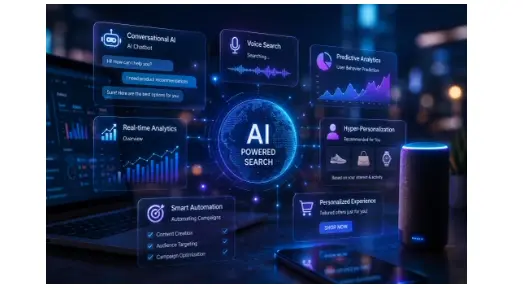
The future of digital marketing is being shaped by Artificial Intelligence (AI), advanced data analytics, and highly personalized user experiences. Traditional marketing methods are rapidly evolving as businesses adopt intelligent technologies that can better understand customer behavior, predict user needs, and deliver more relevant content. In the coming years, digital marketing will increasingly revolve around conversational AI, voice search, predictive analytics, and hyper-personalized content delivery.
One of the most significant developments is the rise of conversational AI. AI-powered chatbots and virtual assistants are transforming the way businesses interact with customers. Instead of relying only on traditional websites and forms, companies can now provide real-time conversations through AI systems that answer questions, recommend products, solve problems, and guide customers through purchasing decisions. These intelligent systems improve customer satisfaction while reducing response times and operational costs.
Voice search is also becoming increasingly important as more users rely on smart devices such as smartphones, smart speakers, and virtual assistants like Siri, Alexa, and Google Assistant. People now search using natural conversational language rather than short keywords. This shift requires businesses to optimize their content for voice-based and question-focused searches. Websites that adapt to conversational search patterns will have a greater chance of appearing in future search results.
Predictive analytics is another powerful technology driving the future of digital marketing. By analyzing large amounts of customer data, AI systems can predict user interests, purchasing behavior, and future trends. Businesses can use these insights to create targeted marketing campaigns, improve customer retention, optimize advertisements, and make smarter business decisions. Instead of reacting to customer behavior after it happens, companies can proactively anticipate customer needs.
Hyper-personalization will also redefine customer engagement. Modern consumers expect content, advertisements, and recommendations that match their individual preferences and behaviors. AI enables businesses to deliver personalized experiences based on browsing history, interests, location, search activity, and purchasing patterns. This creates stronger customer relationships and increases engagement, loyalty, and conversion rates.
In addition, future digital marketing strategies will rely heavily on automation, real-time analytics, and intelligent recommendation systems. Businesses will increasingly use AI to automate content creation, campaign optimization, audience targeting, and customer support operations. Companies that combine AI with strong technical development and user-focused strategies will be able to scale faster and compete more effectively in the digital marketplace.
As technology continues to evolve, businesses that adapt early to AI-driven marketing trends will gain a major competitive advantage in online visibility, customer engagement, brand authority, and long-term digital growth. The future of marketing will not simply be about reaching audiences — it will be about understanding them intelligently and interacting with them in more meaningful and personalized ways than ever before.
Key Technologies Behind AI-Driven SEO
-
Natural Language Processing (NLP) Natural Language Processing (NLP) is a branch of Artificial Intelligence that enables computers to understand, interpret, and process human language. Search engines use NLP to analyze the meaning behind search queries rather than simply matching keywords. This allows search engines to understand conversational language, user intent, context, and semantic relationships between words, leading to more accurate and relevant search results.
-
Machine Learning Algorithms Machine Learning Algorithms allow AI systems to learn from data and improve performance over time without being explicitly programmed. In SEO and digital marketing, machine learning helps search engines analyze user behavior, identify ranking patterns, detect spam, and personalize search results. Businesses also use machine learning tools to improve targeting, automate analysis, and optimize marketing strategies based on real-time data.
-
Semantic Search Semantic search focuses on understanding the meaning and context behind search queries instead of relying only on exact keyword matches. Search engines can now recognize synonyms, related concepts, and user intent to deliver more accurate results. For example, a search for “budget smartphones” may also show results related to “affordable mobile devices” because the AI understands their similar meaning.
-
Search Intent Analysis Search Intent Analysis helps search engines determine what users are actually looking for when they type a query. AI systems analyze whether the user wants information, a product, a service, a comparison, or a direct purchase. Businesses use this technology to create content that directly matches user needs, improving search rankings and customer engagement.
-
Predictive Analytics Predictive Analytics uses AI and historical data to forecast future trends, customer behavior, and marketing outcomes. Businesses can predict which products customers may buy, what content will perform best, and which marketing strategies are likely to succeed. This helps companies make smarter decisions, improve targeting, and increase conversion rates.
-
Automated Content Optimization AI-powered tools can automatically analyze and optimize website content for better SEO performance. These tools help improve readability, keyword usage, metadata, internal linking, and content structure. Automated optimization saves time while helping businesses create content that is both user-friendly and search engine-friendly.
-
AI Chatbots and Virtual Assistants AI Chatbots and Virtual Assistants improve customer interaction by providing real-time responses and personalized support. These systems can answer questions, guide users through websites, recommend products, and assist customers 24/7. In digital marketing, chatbots also help improve engagement, collect customer data, and enhance overall user experience, which indirectly supports SEO and brand visibility.
Conclusion
AI-powered SEO is reshaping the entire digital marketing landscape. The combination of software development, automation, analytics, and intelligent search technologies has created new opportunities for businesses to connect with customers more effectively than ever before. For Assistant Developers and IT professionals, understanding SEO and AI is no longer optional—it is becoming an essential part of modern software and business strategy.