GraphRAG Explained: How Graph Databases Help AI Agents Search Smarter
Most AI search tools today work the same way: turn your question into a vector, find the closest matching pieces of text, and hand them to a language model. This works well until your question depends on how things are connected: "who else works on this topic," "what changed since last year," "which papers cite each other." Plain search cannot see connections. It only sees similarity.
This is exactly the gap that graph databases and GraphRAG are built to close. And it isn't a small or niche idea: Google, LinkedIn, Netflix, Meta, and now Microsoft Fabric all lean on graph technology to power search, recommendations, and, increasingly, AI agents. In this article, we'll explain what a graph database is, what GraphRAG means, how AI agents use a language called Cypher to query graphs in plain English, and how these exact ideas come together in a real-world project.
In this article we'll cover:
- What a graph database actually is, with a simple example
- What GraphRAG means and how it's different from normal RAG
- Cypher and Text2Cypher: how AI agents ask graph questions in plain English
- Real systems already using graph technology at huge scale
- Neo4j vs Memgraph: how to pick a graph database
- A real-world example of GraphRAG in practice
What Is a Graph Database?
A normal database stores information in tables: rows and columns, like a spreadsheet. That works fine until you need to ask a question about how things relate to each other. "Which authors have worked together?" or "which papers share a topic?" In a table-based database, answering that means writing several JOIN statements and hoping your database can handle them fast enough.
A graph database stores data differently. Instead of rows and columns, it stores:
- Nodes: the "things" (a person, a paper, a company, a product)
- Edges: the relationships between things ("wrote", "works at", "cites")
- Properties: extra details attached to nodes or edges (a date, a name, a score)
Relationships are stored directly, not calculated on the fly. So instead of joining five tables to find "authors who share a genre with Ana Rivera," the database just follows the existing connections.
💡 Why This Matters The relationships are stored as first-class data, not recalculated every time. That's what makes multi-hop questions (ones that need two or three "hops" across relationships) fast, even on large datasets.
What Is GraphRAG?
GraphRAG stands for Graph Retrieval-Augmented Generation. It follows the same basic idea as normal RAG (give the language model real data instead of letting it guess), but it retrieves that data from a graph instead of a flat list of text chunks.
Normal RAG breaks documents into chunks, turns each chunk into a vector, and finds the chunks that are most similar in meaning to your question. This is great for single-fact questions. It struggles the moment your question depends on a relationship that spans more than one chunk.
Example: "Which other authors have written a Mystery novel, and have any of them worked together?" A pure vector search will find chunks that mention "mystery", but it has no reliable way to work out who collaborated with whom. A graph already stores that connection directly, as an edge between two author nodes.
GraphRAG shines whenever the answer depends on structure, not just wording: research and citation analysis, fraud detection, supply chains, legal and compliance documents, and enterprise knowledge bases that span many linked documents.
How GraphRAG Answers a Question
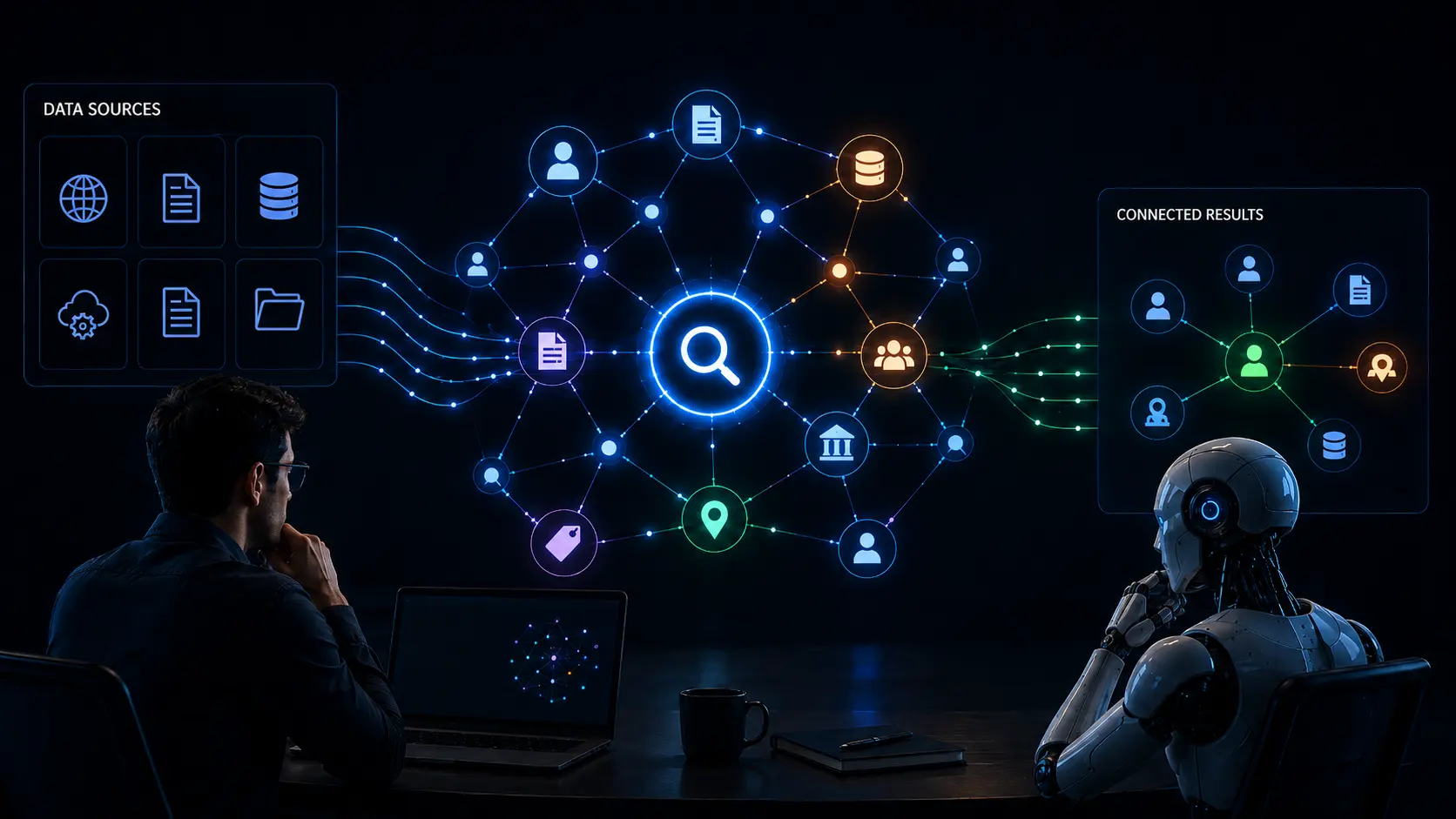
The flow, step by step:
- You ask a question in plain English.
- An AI agent turns your question into a graph query (more on this below).
- The graph database traverses (follows) the actual relationships that exist between nodes.
- Connected facts come back: not just one matching item, but the full web of related authors, books, and genres.
- The language model writes its answer using those real, connected facts, instead of guessing.
🚀 The Key Difference Normal RAG asks: "What text looks similar to this question?" GraphRAG asks: "What is actually connected to what I'm looking for?" The second question is what makes multi-hop reasoning possible.
Cypher and Text2Cypher: Teaching AI Agents to Ask Graph Questions
Graph databases have their own query language, and the most widely used one is called Cypher. It reads a bit like drawing the pattern you're looking for. This line finds every Mystery book published after 2020:
MATCH (b:Book)-[:GENRE]->(g:Genre {name: "Mystery"}) WHERE b.year > 2020 RETURN b.title
Cypher is powerful, but most people (and most business users) don't know it, and shouldn't need to. This is where AI agents come in. A well-known pattern called Text2Cypher (or NL2Cypher) uses a language model to translate a plain-English question directly into a working Cypher query, run it, and hand the results back.
This is a well-recognised building block for AI agents: instead of the agent guessing an answer, it writes a real database query, executes it, and grounds its response in what actually comes back. It's the same idea as giving a colleague database access instead of asking them to answer from memory.
- Large graphs mean large schemas: feeding an AI agent the entire schema can overload its context, so production systems usually retrieve only the relevant part of the schema first.
- Generated queries aren't always perfect the first time: good systems add retry logic that catches an error and tries again, a few times, before giving up.
- The more specific your relationships and property names are, the more reliably an AI agent can generate a correct query.
⚡ Why It's Exciting for AI Agents Text2Cypher turns a graph database into a tool an AI agent can use on its own, the same way it might call a weather API or a calendar. Ask a question in English, get back an answer grounded in real, connected data.
Real Systems Already Using Graph Technology
This isn't a future idea: it's already running behind some of the products you use every day. Here's a quick look at who relies on graph technology, and why.
Netflix: a 650 TB graph, built for speed Netflix runs an internal system called Graph Abstraction, handling close to 650 terabytes of graph data at roughly 10 million operations per second. It powers three very different jobs at once: a real-time map of relationships across the whole platform, a social graph inside Netflix Gaming, and a live map of internal services used to investigate outages. Separately, Netflix uses a graph neural network called SemanticGNN, which blends "people who watched this together" signals with "this has a similar genre and mood" signals in a single graph, which helps recommend newer titles that don't have much viewing history yet.
LinkedIn and Meta: graphs built for their own scale LinkedIn built its own graph engine, internally called Liquid, to serve its Economic Graph in real time: it's what powers "People You May Know" and job recommendations. Meta (Facebook) built TAO, a graph store that renders your News Feed by following the social graph with strict privacy checks, at a scale of billions of reads per day. Both companies chose to build custom systems rather than use an off-the-shelf graph database, because at their scale, every millisecond and every byte matters.
Microsoft Fabric: bringing LinkedIn's graph tech to every business In 2025 and 2026, Microsoft began rolling out a graph layer inside Microsoft Fabric, built directly on the relationship-modelling ideas proven at LinkedIn. The goal is to give enterprise AI agents a real, queryable model of how a business's data connects (customers to purchases, suppliers to products) instead of forcing an agent to guess at relationships hidden across separate tables.
🏆 The Pattern to Notice None of this is new: Google, LinkedIn, and Facebook have used graph thinking for over a decade. What's new is that the exact same pattern is now being pointed at LLMs and AI agents, and packaged for any company to use, not just hyperscalers.
Choosing a Graph Database: Neo4j vs Memgraph
If you're building your own system rather than a hyperscale internal platform, you'll likely pick between a small number of production-ready graph databases. The two most common are Neo4j (the original and most established) and Memgraph, a newer, faster alternative built for real-time workloads.
Neither is "better": they're built for different trade-offs. If your dataset is huge and mostly historical, Neo4j's maturity and tooling are hard to beat. If you need low-latency answers for a live AI agent working over a graph that comfortably fits in memory, Memgraph is built exactly for that case.
A Real Example: Building a Research Knowledge Graph
These exact ideas come together in an Arctic research trends dashboard: a system designed to help researchers explore scientific literature the way it actually behaves, as a web of authors, papers, institutions, and topics, not a flat list of search results.
- Every paper, author, institution, and topic became a node, and every "wrote", "cites", and "works at" relationship became an edge, using Memgraph as the graph engine.
- An NL2Cypher question-and-answer layer lets a researcher ask a plain-English question and get back an answer grounded in the actual graph, not a guess.
- A vector semantic search layer sits alongside the graph, for the cases where meaning-based search is genuinely the right tool.
- An "Expert Finder" feature uses graph traversal to answer a very graph-shaped question, "who are the right people to talk to about this topic?", by following co-authorship and topic relationships, not just keyword matches.
This mirrors the exact GraphRAG pattern described above: a plain-English question, translated into a graph query by an AI agent, answered with real connected facts. It's a good example of how a pattern that started at hyperscalers is now practical for a much smaller, focused project.
GraphRAG vs Normal RAG: Side by Side
Wrapping Up
Graph databases and GraphRAG aren't a replacement for everything you already know about RAG: they're an extra tool for the specific moment when your data's real value lives in its relationships, not just its words. The pattern is proven: Google, LinkedIn, Netflix, and Meta have built entire products on it, and Microsoft is now packaging that same idea for every enterprise, aimed squarely at AI agents.
- A graph database stores relationships directly, so multi-hop questions stay fast even at scale.
- GraphRAG retrieves a connected web of facts instead of isolated text chunks.
- Cypher and Text2Cypher let AI agents query a graph in plain English, and ground their answers in real data.
- Choosing Neo4j vs Memgraph (or another graph database) comes down to your data size and how real-time your workload needs to be.
When you choose the right tool for the shape of your data, not just the popular one, you stop fighting your database and start building something that actually understands how your information connects. That's the real goal.