Enterprise AI Agents in the Nordics: How Businesses Are Moving From AI Tools to AI Workforces
Artificial intelligence is quickly becoming part of everyday business operations across the Nordic region. Companies in Sweden, Norway, Denmark, Finland, and Iceland are no longer looking at AI only as a tool for generating text, answering questions, or supporting simple automation.
The next step is already happening.
Businesses are beginning to introduce Enterprise AI Agents that can understand tasks, use business data, connect with company systems, communicate with employees and customers, and complete work with limited human involvement.
For Nordic companies, this represents a major shift in how digital transformation, automation, productivity, and customer experience are approached.
What Are Enterprise AI Agents?
Enterprise AI Agents are intelligent software systems designed to perform business tasks with a higher level of independence.
Traditional software normally waits for a person to tell it exactly what to do. An AI agent can understand a goal, identify the information it needs, decide what actions to take, interact with different systems, and complete the task.
For example, an Enterprise AI Agent could receive a customer enquiry, check the company's knowledge base, review order information, prepare an answer, update the customer record, and notify a human employee if further support is required.
Instead of using several separate tools, the employee or customer interacts with one intelligent system.
This is why many companies are beginning to see AI agents as digital colleagues rather than simple software features.
Why Enterprise AI Agents Matter in the Nordics
The Nordic countries have always been strong adopters of digital technology.
Sweden, Denmark, Finland, Norway, and Iceland have highly connected economies, strong digital infrastructure, modern businesses, and a workforce that is comfortable using digital services.
At the same time, Nordic companies face challenges that make AI adoption increasingly important.
Businesses need to improve productivity while controlling costs. Skilled employees are expensive and difficult to recruit in many industries. Customers expect faster responses. Companies also operate across several languages and markets.
Enterprise AI Agents can help address many of these challenges.
They allow companies to automate repetitive work while giving employees more time to focus on customers, innovation, strategy, and complex decisions.
AI Agents Are Different From Traditional Automation
Business automation is not new.
Companies have been using workflow tools, scripts, robotic process automation, and business systems for many years.
However, traditional automation normally works best when the process is predictable.
For example, if A happens, the system performs B.
Enterprise AI Agents can work with situations that are less structured.
An AI agent can understand natural language, interpret documents, search knowledge, analyse information, communicate with other systems, and decide which step should happen next.
This makes AI agents useful for business processes that previously required human judgement.
The result is a more flexible form of enterprise automation powered by artificial intelligence.
Customer Service Is One of the First Areas to Change
Customer service is becoming one of the most practical areas for Enterprise AI Agents in the Nordics.
Many businesses already use chatbots, but traditional chatbots often follow predefined questions and answers.
AI customer service agents are much more capable.
They can understand what the customer is asking, search company information, provide relevant answers, communicate in several languages, collect details, create support cases, and involve a human employee when necessary.
For companies operating across Nordic and European markets, multilingual AI customer support can be particularly valuable.
A customer in Sweden could communicate in Swedish while another customer communicates in English, Finnish, Danish, or Norwegian.
The same AI system can support them around the clock.
Enterprise AI Agents Can Support Employees Too
AI agents are not only customer facing.
One of the biggest opportunities is the development of Internal AI Assistants.
Many employees spend a surprising amount of time searching for information.
They look through documents, emails, internal systems, manuals, policies, project folders, and knowledge bases just to find the answer to a simple question.
An Internal AI Agent can become a central interface for company knowledge.
An employee could simply ask:
- "What is our process for onboarding a new customer?"
- "What happened with this project last month?"
- "Where can I find the latest safety procedure?"
- "What products are available from this supplier?"
The AI agent can search approved company data and provide the relevant information immediately.
For larger Nordic organisations, this can significantly improve internal knowledge management.
AI Agents and ERP Systems
Another important area is connecting AI with enterprise systems.
Many Nordic companies already use ERP, CRM, accounting, warehouse, HR, project management, and business intelligence platforms.
The challenge is that important information is often spread across several systems.
Enterprise AI Agents can become an intelligent layer between employees and business software.
Instead of manually opening several applications, an employee could ask:
- "Which customer invoices are overdue?"
- "Show me the projects that are currently over budget."
- "Which products have the lowest stock levels?"
- "Summarise this month's sales performance."
The AI agent can retrieve the relevant information from connected systems and present it in a clear and understandable way.
This is where Enterprise AI integration becomes especially powerful.
Private AI and Data Security Are Important in the Nordics
Data privacy is one of the most important considerations when Nordic companies adopt artificial intelligence.
Businesses need to understand where their information is processed, how it is stored, who can access it, and how AI models interact with company data.
For organisations working with sensitive business information, healthcare data, industrial information, intellectual property, government information, or confidential customer records, public AI services may not always be suitable.
This is increasing interest in private AI, self hosted AI, and local LLM solutions.
A company can run an AI model within a controlled infrastructure and connect it only to approved business data.
This gives organisations greater control over security, access, compliance, and data governance.
For many Nordic enterprises, this may become an important part of their long term AI strategy.
Human Employees Will Still Be Essential
AI agents are often discussed as replacements for employees, but this is not the most useful way to look at the technology.
The strongest results usually come from combining people and AI.
AI agents are very good at processing information, handling repetitive requests, searching large amounts of data, summarising documents, monitoring systems, and completing routine workflows.
Humans are still better at relationships, leadership, creativity, negotiation, empathy, complex judgement, and strategic decisions.
The goal should therefore be to create a workplace where AI handles more of the repetitive digital workload while employees focus on higher value activities.
For Nordic companies, this human and AI collaboration could become an important competitive advantage.
Where Can Nordic Companies Use Enterprise AI Agents?
The number of potential applications is growing quickly.
- Customer service teams can use AI agents to answer enquiries and support customers.
- Sales teams can use them to research prospects, prepare information, update CRM systems, and create follow up material.
- Finance departments can use AI to analyse financial information, invoices, payments, and reports.
- HR teams can use internal AI assistants to answer employee questions and support onboarding.
- Industrial companies can connect AI agents with maintenance information, safety documentation, operational data, and internal procedures.
- Management teams can use AI to analyse information from several business systems and generate faster business insights.
The important point is not to introduce AI everywhere at once.
Companies should begin with a clear business problem.
How to Start With Enterprise AI Agents
Successful Enterprise AI adoption normally begins with a practical use case.
The first question should not be:
"How can we use AI?"
A better question is:
"Which business process takes too much time today?"
Look for tasks that are repetitive, information heavy, slow, or dependent on employees manually searching through several systems.
Then identify the data, integrations, security requirements, and people involved.
A small AI agent project can then be tested with real users.
Once the company understands what works, the solution can gradually expand.
This approach reduces risk and makes it easier to measure the actual business value of AI.
The Future of Enterprise AI in the Nordics
Enterprise AI Agents are likely to become an increasingly normal part of Nordic workplaces.
In the coming years, employees may work with several specialised AI agents.
- One agent may handle customer support.
- Another may analyse company data.
- Another may support sales.
- Another may help employees search internal knowledge.
- Another may monitor operations and identify problems.
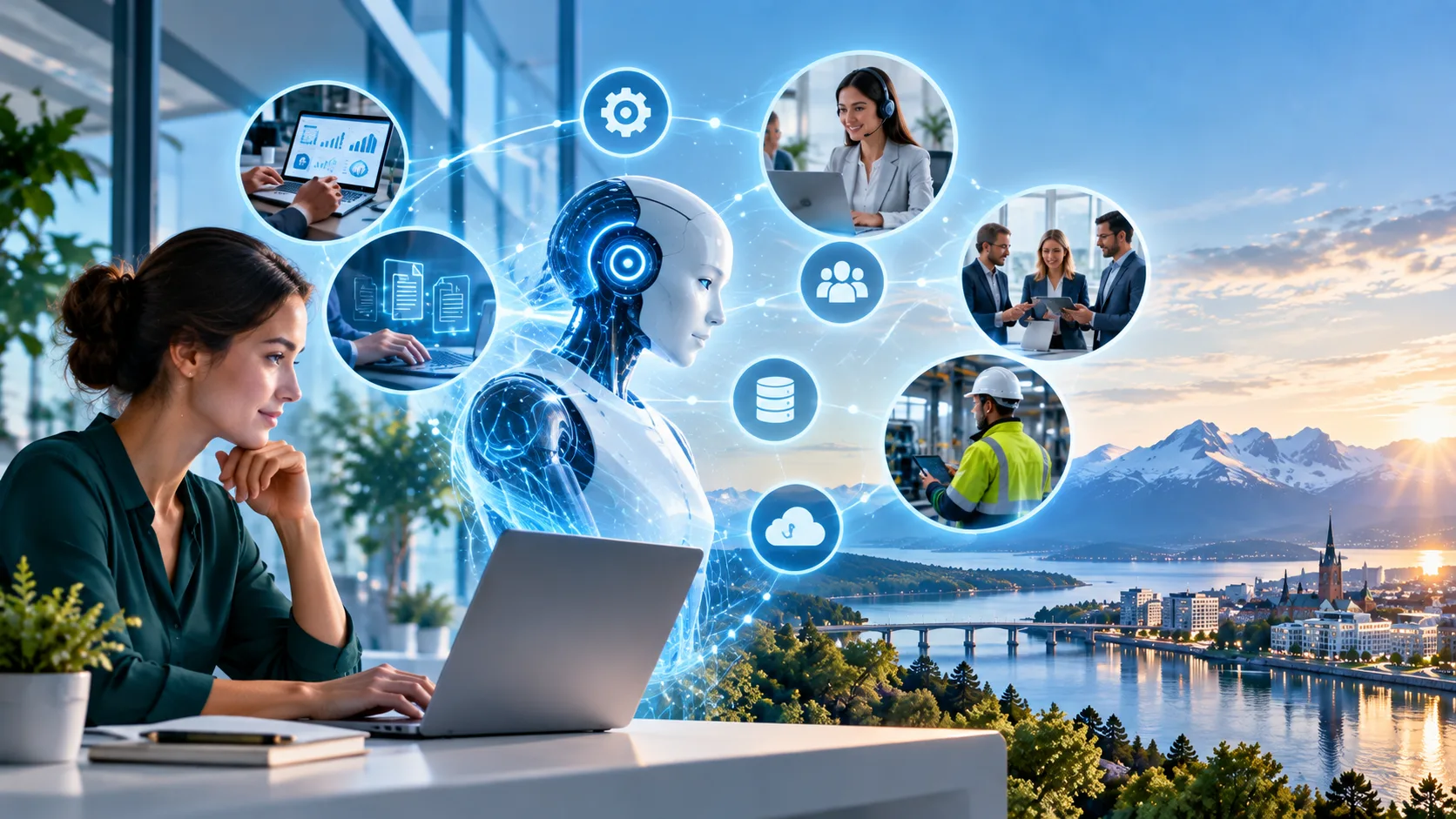
Together, these systems can create a new type of digital workforce.
The companies that benefit most will probably not be those that simply adopt the newest AI technology.
They will be the companies that understand where AI creates real business value and connect it carefully with their people, processes, data, and existing systems.
Building a Practical AI Strategy
For companies in Sweden and across the Nordics, Enterprise AI is becoming less about experimentation and more about implementation.
The opportunity is not simply to add an AI chatbot to a website.
The bigger opportunity is to create intelligent systems that understand company knowledge, connect with business software, support employees, communicate with customers, and automate real business processes.
Enterprise AI Agents can help Nordic companies become faster, more efficient, more responsive, and better prepared for the next stage of digital transformation.
The most important step is to start with a real business need.
From there, AI can become much more than another piece of software.
It can become an active part of how the organisation works.